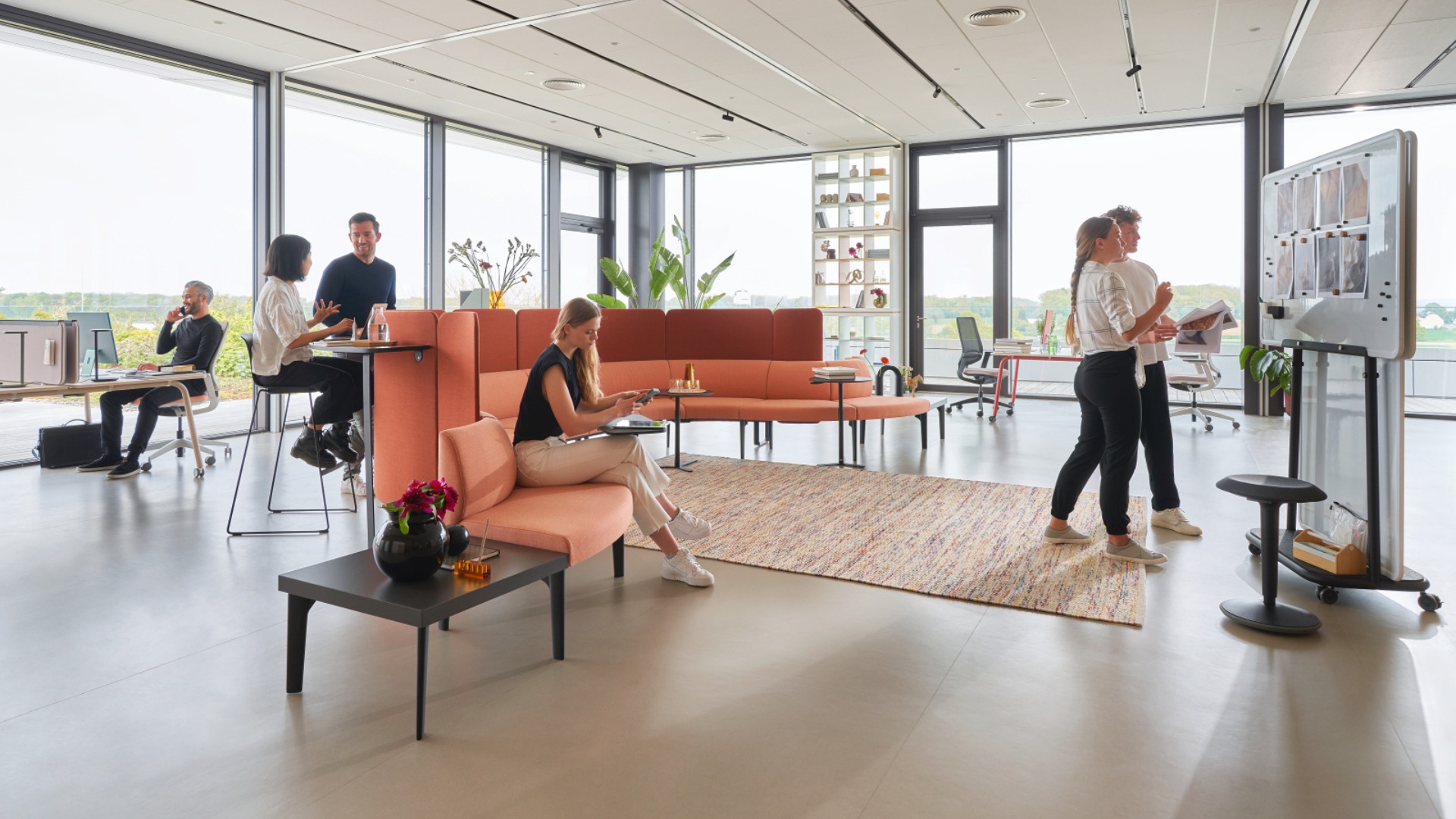

When brief encounters open up new perspectives
It often starts with a short conversation at the coffee machine. With a chance encounter on the way to the next meeting. Or with a colleague from another department whom you only know by sight.
A few minutes later, a new thought suddenly emerges.
Not every good idea is born in a workshop, a scheduled brainstorming session or within a well-established team. Sometimes it is precisely the people we only meet occasionally who point us towards something we had not seen before.
In network research, these relationships are often described as “weak ties”: loose connections with acquaintances, distant colleagues or people outside our immediate working environment. The concept goes back to sociologist Mark Granovetter, who showed how important such weaker connections can be for the exchange of information between different social groups.
For modern workplace design, this raises an interesting question:
What happens when an office not only supports collaboration within existing teams, but also enables encounters between people who might otherwise never exchange ideas?
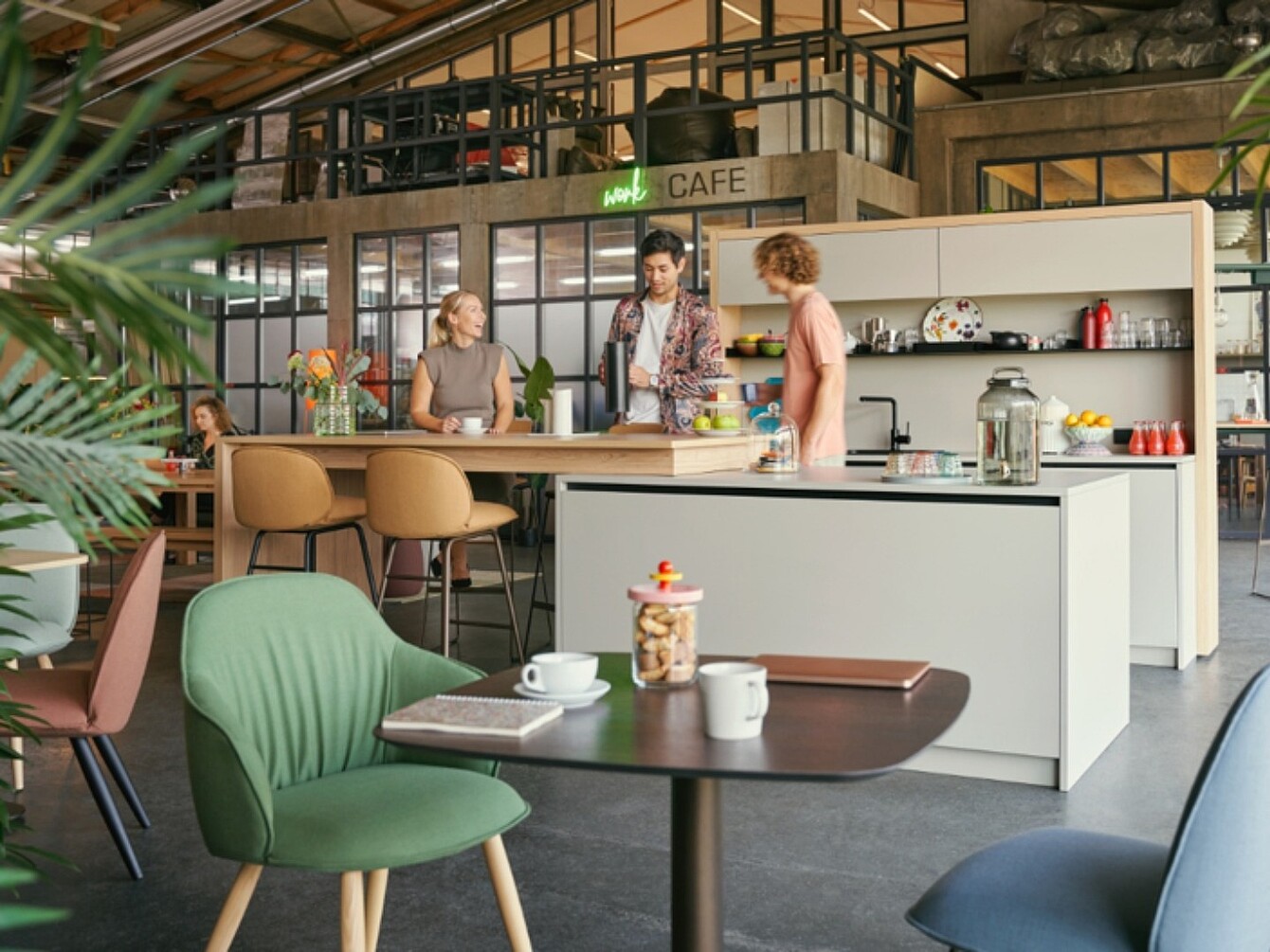


Weak ties: Why loose connections can be so valuable
With close colleagues, we often share a great deal: the same projects, the same meetings, similar information and often comparable challenges.
That is important. Strong relationships build trust, make coordination easier and provide the basis for close collaboration.
At the same time, this proximity can also mean that information circulates within a relatively closed group.
Weak ties work differently.
A colleague from another department may work with entirely different customers. Someone from another team may use a method that nobody in your own area has considered yet. A brief conversation with someone from development, sales, marketing or production can therefore bring together very different worlds of knowledge.
What matters is not necessarily the length of the conversation.
It is the distance between the perspectives.
Weak ties can act as bridges between groups that would otherwise have little contact with one another. This allows information, experiences and ideas to travel into areas where they are still new.
That does not mean loose connections are always more important than close relationships.
Both are needed: strong relationships to explore topics in depth together – and weaker connections to continuously bring fresh impulses from outside into one’s own network.
Innovation is not always on the calendar
Monday, 10 a.m.: innovation meeting.
Creativity rarely works that neatly.
Of course, workshops, project meetings and creative processes can be planned deliberately. But the moment when a new connection becomes visible does not necessarily follow a schedule.
Ideas often emerge when information meets unexpectedly.
Over coffee.
On the way to the desk.
While lingering for a few minutes after a meeting.
Or simply because two people happen to be in the same place at the same time.
This is one of the strengths of informal communication: it often begins without a specific goal. There is no agenda, no presentation and no clearly defined role.
As a result, a conversation can move in a direction nobody had planned.
Someone may casually mention a problem. The other person may have experienced a similar situation in a completely different project. An idea emerges, a contact is suggested or a solution from another context suddenly becomes relevant.
A few minutes can lead to something that might never have surfaced in a scheduled meeting.

Crossroads: Where paths are allowed to intersect
For these kinds of encounters to happen, people first need the opportunity to meet.
This is where the idea of crossroads comes into play.
Crossroads are places where different routes through a workplace come together: entrance areas, central staircases, communal zones, work cafés, printer areas, standing tables or transitions between different work settings.
What matters is less the individual place than its position within the overall spatial concept.
A coffee machine at the end of a rarely used corridor does not automatically create a lively meeting point.
An attractive shared area located between several teams, however, can naturally become part of many people’s everyday routes.
People pass by, pause for a moment, recognise someone and start talking.
The space does not dictate the encounter.
It simply increases the likelihood of it happening.
Chance cannot be planned – but it can be enabled
This is one of the greatest challenges in workplace design.
Spontaneous encounters lose their value when they are over-engineered.
Nobody wants to be forced into interacting with five colleagues on the way to their desk. Nor should every circulation area automatically become a communication zone. People who need to concentrate still require calm, control and places to withdraw.
Good crossroads therefore do not feel like a permanent networking event.
They create opportunities rather than obligations.
Different spatial qualities are important:
- central locations where natural routes intersect
- inviting areas that encourage people to pause briefly
- standing and seating options for spontaneous conversations
- open areas for quick encounters
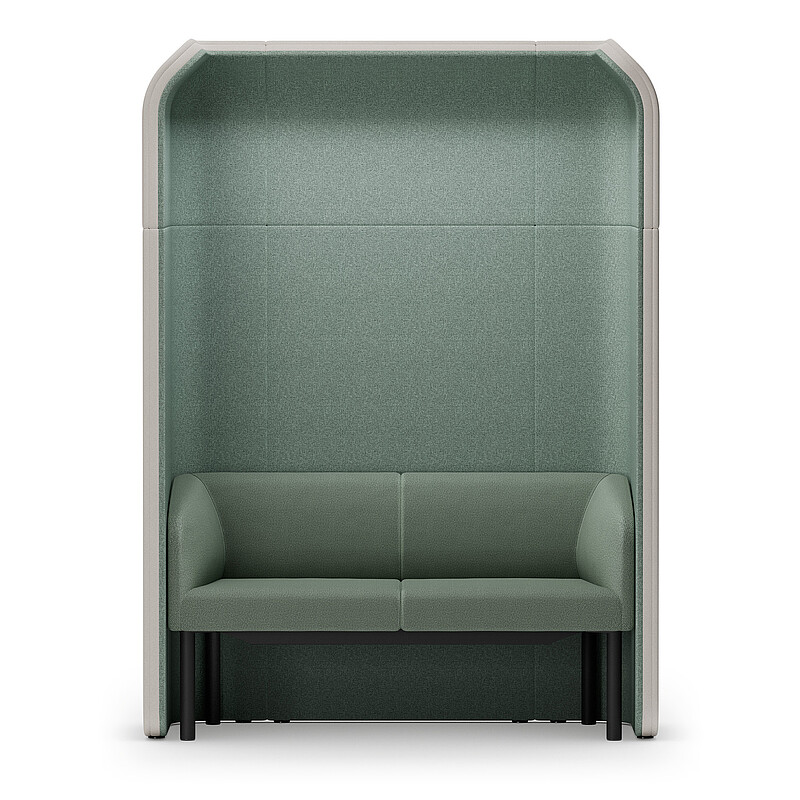
- semi-sheltered settings where a short exchange can develop into a longer conversation
- sufficient distance from zones dedicated to concentrated work
This creates a kind of spatial progression.
An encounter may begin in passing. It may continue for five minutes at a standing table. If the topic becomes relevant, the conversation can then move to a quieter area.
The workplace supports interaction without prescribing it.


From corridor to social space
For a long time, corridors, entrance areas and transitional spaces were viewed primarily from a functional perspective.
They moved people from A to B.
Today, these same areas can take on an additional role.
Not every square metre of a workplace needs to be assigned exclusively to one clearly defined activity. In particular, the spaces between traditional work settings can serve important social functions.
A widened transition area may include a small standing table.
The zone outside a meeting room can become an informal waiting and conversation area.
The central kitchen can be positioned not at the edge of the office, but as a deliberately designed meeting point.
Or a work café can combine eating, working, informal exchange and short breaks in one place.
In this way, space is not only used efficiently.
It gains a social dimension.
Hybrid work makes chance encounters more valuable
Hybrid working adds another layer to the issue.
When people are no longer in the office every day, they automatically have fewer spontaneous encounters.
Digital communication can support planned collaboration extremely well. A message can be sent, a video call can be scheduled and projects can be worked on together online.
What is much harder to digitise is everything that happens in between.
People usually do not spontaneously call a distant colleague they have not spoken to in months just to share a two-minute observation.
In the office, this can happen simply because both happen to be standing at the coffee machine at the same time.
That gives shared time in the office a different quality.
The decisive question is therefore not only:
How many people are in the office at the same time?
But also:
How many different people actually have the opportunity to encounter one another while they are there?


The office as a network
Perhaps offices should therefore be seen less as a collection of individual workplaces.
And more as a physical network.
There are spaces for concentration.
Spaces for collaboration.
Spaces for recovery.
And in between, there are connections, nodes and intersections.
This is exactly where something can emerge that is difficult to plan: a brief exchange between two people whose working worlds would normally barely overlap.
For workplace planning, this means looking not only at rooms, but also at movement.
Where do people arrive?
Which routes do they take?
Which teams regularly cross paths – and which never do?
Where do natural waiting moments occur?
Which places attract people from different areas?
And where might it be worthwhile turning a simple passageway into a place where people are happy to stay for a few minutes?
Crossroads do not emerge automatically from an open-plan layout. What matters is a balanced interplay of proximity, movement, quality of stay and freedom of choice.
Because encounters require openness.
Productivity also requires retreat.
A good office offers both.
The most valuable encounter may be the one that was never planned
The quality of an office is not only reflected in how well a team can work together.
It is also reflected in the new connections that can emerge there.
Between departments.
Between hierarchical levels.
Between people with different areas of expertise.
And between colleagues who may previously have known each other only by sight.
Weak ties remind us that innovation does not emerge exclusively within well-established teams. New perspectives often come from places where different networks come into contact.
Crossroads give these points of contact a place.
The office of the future therefore does not only connect people who already work together.
It creates opportunities for people who do not yet know that they have something to say to each other.

social media channels: